Labels

Showing posts with label Vampatella. Show all posts

Tuesday, September 30, 2025


The Story of Angela Falconeri

Angela Falconeri was born on October 12, 1876, in the small Sicilian town of Acate (then called Biscari). She came from a family with deep roots in Sicily, though their lives were marked by the same hardships that touched many families of that time.
Angela's Ancestors

Angela's grandfather, Carmelo Falconeri, was born in the late 1700s. He married Anna Nicosia around 1819, and together they had three children. Tragically, Anna died in August 1830, leaving Carmelo a widower with young children. Just three months later, Carmelo married fifteen-year-old Salvatrice Miceli. Though their age difference was large, this was not unusual in Sicily at that time. Together, Carmelo and Salvatrice had nine children, building a large family despite the difficult times.

Their son Salvatore, born in 1833, grew up and married Francesca Puglisi in 1861. Salvatore and Francesca became Angela's parents, and Angela was their fifth child out of six. She grew up in a household where family was everything, and children were both a blessing and a source of worry in an age when many did not survive to adulthood.
Angela's Life and Marriage

On November 12, 1896, twenty-year-old Angela married Biagio Vampatella. Biagio worked for the Italian railroad, and his job was to keep the tracks clear for the trains. This work took them to different locations across Sicily as they followed where the railroad needed him. Between 1897 and 1913, Angela gave birth to eight children: Filippo, Salvatore, Giovanina, Angelina, Maria, Giuseppe, Giovanni, and Mario.

But Angela's life as a mother was filled with heartbreak. She lost two of her young sons, Salvatore and Giuseppe, while they were still small children. These losses must have weighed heavily on her heart.
Separation and Loss

In April 1913, Biagio made the difficult decision that many Italian men were making at that time—he would go to America to find better opportunities. He took their oldest son, sixteen-year-old Filippo (who would become Philip in America), and left for New York. Angela stayed behind in Sicily with their other children, and she was pregnant at the time. In October 1913, she gave birth to twin boys, Giovanni and Mario.

Angela never saw the shores of America. While Biagio and Philip were working odd jobs in New York, trying to build a new life, Angela faced another devastating loss back in Sicily. The twins, Giovanni and Mario, died when they were about two years old.

We don't know exactly when Angela passed away, but it was sometime before 1920. Philip never saw his mother again after he left Sicily in April 1913.
After Angela

Biagio returned to Sicily, and we don't know if he was able to be with Angela before she passed away. He stayed in Sicily until 1920, when he brought his three daughters—Giovannina, Angelina, and Maria—to America. He settled in New York, where he lived until his death in 1939.

All of Angela and Biagio's children who survived—Philip, Giovannina, Angelina, and Maria—built their lives in America and started families of their own.
Angela's Legacy

Angela Falconeri lived through times that we can barely imagine today. She moved from town to town as her husband's work demanded. She buried children. She said goodbye to her husband and oldest son, not knowing when she would see them again. She cared for the twins, Giovanni and Mario, and endured their deaths when they were just two years old.

Though we know few details about Angela's personality or her daily life, we know this: she was strong enough to endure what life gave her. She was our great-grandmother, and through her children—Philip, Giovannina, Angelina, and Maria—her story continues in all of us.

When we gather as family, we carry Angela's blood and her strength, even if we never heard her voice or saw her face. Her life reminds us that our family's journey to America came at a great cost, paid by those like Angela who stayed behind in Sicily.

Saturday, March 1, 2025

 Prompt: Family Secrets


Grandpa Vamp's Secret Five-Dollar Club

Growing up, family secrets weren't something we discussed openly. But some secrets are too good not to share—like those involving my enigmatic Grandpa Vamp.

Grandma Vampatella (born Antoinette Rapuano) passed away when I was barely two years old, leaving me with no personal memories of her. At the time of her death, she had eight grandchildren, with me being the youngest. My only glimpses of her come from old family movies—particularly footage from my oldest cousin Mary Francis's 10th birthday celebration at my grandparents' house. In these grainy films, you can see Mary opening a present from Grandma and immediately rushing over to plant a thank-you kiss on her cheek.

Like in many families, Grandma was the gift-giving mastermind behind birthdays and holidays. When she died, Grandpa Vamp was adrift—so much so that several years later, he remarried a woman he affectionately (or not so affectionately) referred to as "the blister." Her actual name was Catherine, but those of us who remembered Grandma refused to call her "Grandma"—she was strictly "Aunt Katie" to us. Whether Aunt Katie ever took up the mantle of birthday gift-giver remains lost to family history.

But here's where the story gets interesting. If you happened to be at Grandpa's house on your birthday, he'd mysteriously beckon you to a quiet corner, press a crisp five-dollar bill into your palm, and with conspiratorial seriousness whisper, "Don't tell anyone—this is our secret." For years, each of us grandkids thought we were special, the sole member of Grandpa's clandestine five-dollar club.

It wasn't until we were adults, swapping childhood stories, that we discovered Grandpa's elaborate web of "secrets." My cousin Marie and I compared notes and realized we'd both been sworn to silence over identical five-dollar birthday handouts. When we expanded our investigation, the results were... inconsistent. My oldest cousin Mary claimed she never received anything beyond the occasional Tootsie Roll. My brother insists all he ever got for cutting Grandpa's lawn was a single jellybean!

Was Grandpa playing favorites? Was he simply forgetful? Or was this his peculiar way of creating special moments with each grandchild, letting us feel like we shared something unique with him, even if that something was just a modest bill and a contrived secret?

Whatever his motivation, Grandpa Vamp was undeniably a character—one whose quirky rituals have given us stories to share long after those five-dollar bills were spent.


Wednesday, October 23, 2024

 Prompt: Homestead


When I got the prompt "homestead", my mind fluttered to the endless prairies of the American West, where brave souls carved lives out of rugged land. But homesteading, at its core, transcends those storied fields; it encompasses the essence of "home" itself.  For me and my mother (and I will guess for others) that sanctuary rested at 145 Cedarhurst St in North Great River, New York - the cherished abode of my grandfather, Philip Vampatella.


Sundays at Grandpa's house was transformed into a family affair. Aunts, uncles and cousins flocked to see each other and grandpa.  Sometimes, upon arrival, a game of pinochle was going on. Grandpa was known for his cheating tactics! Other times, grandpa was seated at his handcrafted bench at the table. Rings of smoke from his Chesterfields engulfed him. Next to him was a jelly glass filled with red Gallo wine. Katie, his second wife, would be at the stove making something that would make my father's mouth water. 

The homestead was situated on 2 acres, its U-shaped driveway the setting for countless unaccompanied driving lessons - my brothers, cousins and I, navigating the loops with unbridled joy, our hearts racing as we cherished those fleeting moments of freedom. A sturdy oak tree, our playground, stood sentinel by the detached garage, while the faint silhouette of a parked car traced an indelible memory I never quite captured.  

A miniature house, otherwise known as the "chicken coop" was where grandpa's sister, Mary lived. Unmarried and cared for by grandpa, Aunt Mary welcomed visitors with the warmth of bread and jelly in her modest home - an abode perhaps no larger than ten by twenty feet. She had a yappy little dog named Lammy. No one really liked him, but he was company for her.  

Nestled beside her tiny dwelling was grandpa's workshop, a testament to his craftsmanship. Once his first home, it transformed into a hub of creativity as he lent his skilled hands to carpentry. Machinery hummed, sawdust danced in motes of light, and the rich scent of fresh-cut wood enveloped me like a nostalgic embrace. I would collect leftover scraps to create my own miniature towns in the backyard fueled by imagination.

So how did a young man from Vittoria, Sicily who arrived in the United States at the age of 15 with his father, Biagio and didn't speak a word of English come to make a homestead in Great River, Long Island? 

In 1920, after completing his service in the army during WWI, Philip welcomed his father, Biagio back to the United States.  A few years prior, Biagio was summoned back to Sicily for unclear reasons, but while he was there his wife had died.  Biagio and his 3 daughters, Giovannina, Angelina and Maria arrived in the US.  Giovannina and Angelina were quickly married off and Maria (Mary) remained unmarried and cooked and cleaned for her brother and father.  The 3 Vampatella's were living in cheap, close quarts in Marion, Jersey City, New Jersey. Marion had a large concentration of Italians and warehouses where laborers could work.  


The city's cobblestone streets echoed with the cacophony of traffic, a symphony of honking horns, shouting vendors, and the relentless clanking of trains.  As a railway hub, Marion was a hive of activity, its air thick with the noxious blend of industrial fumes and the swampy stench that grandpa described as a "cocktail served to all and sundry." Yet, amidst this chaotic, sensory-overloading environment, Biagio and Philip found a way to thrive, working diligently and saving their hard-earned money.


One day in 1921, while perusing the newspaper, an ad caught the eye of Philip. It said something to the effect of: 

Prime Long Island Real Estate!

Attention, aspiring landowners!!

 Here’s your golden opportunity to acquire a generous plot of ground on picturesque Long Island!


Nestled amid lush vegetation and offering a tranquil escape, this splendid piece of land is but a stone’s throw away from the shimmering shores of the sea. Imagine the soothing sounds of the waves and the gentle sea breeze right at your doorstep!


Located just a few hundred feet from the charming center of town, you’ll enjoy the perfect harmony of serene countryside living and convenient access to local amenities.


All this can be yours for the astonishingly low price of just $250!  

Don’t let this incredible opportunity slip through your fingers! First come, first served. Act now and secure your slice of paradise!


Philip and Biagio took the train to Great River, Long Island and met with the agent from the "House and Home Company". From the train station they climbed into a Ford Model T taxi and headed north on a dusty dirt road. The driver left the 3 of them in this vast empty plot of land. Grandpa describes this place in Passeggiata

"This place was all the ad had claimed. Vast expanses of scrub oak vied shoulder high against the taller jack pines hugging loftier elevations. There was no visible sign of human habitation; only a virgin sea of green split by a dusty road coming to a dead-end declivity. The road, main drag of the area, was Connetquot Avenue."

Philip was a little disappointed it wasn't a "stone's throw" away from the sea and complained to the agent.  They walked about 2 miles more and there was a clear strip of land that was later to be called Cedarhurst St. The road was not paved.  There was no power, no water, no telephone wires - there was nothing. It wasn't even close to a town that the ad had mentioned! Biagio and Philip discussed whether this is where they wanted to settle.  No city, no noise, no foul-smelling air, no garbage. Biagio said, "..it was as God had made it, very nice." 

Philip turned to the agent and said, "We'll take one acre" and gave him a deposit. Biagio now owned a piece of America!! But having land and building a home were two different things. A home was a lot more money and time and until they could build that home, Philip, Biagio and Mary moved away from the chaos of Marion, New Jersey and out to Long Island closer to their future. 

By 1924, Biagio was diligently working alone to clear his land and dig a hole for his new home.  Meanwhile, Philip was navigating the challenges of married life with his beloved Antoinette Rapuano. He made a point for her to visit her family in New Haven twice a month, all while managing their life on Long Island.  After welcoming 2 children, Antoinette grew weary of the cramped quarters, the outhouses, and the burden of paying rent. A quiet woman who "asked for nothing" found the courage to request her hardworking husband to provide her with a proper home. 

In 1927, Philip took a significant step towards realizing his dream by purchasing two acres of land on Cedarhurst Street for $800. with determination and resourcefulness, he set about building his family's home from the ground up.  Philip salvaged wood from old stables and sheds belonging to the Belmont company, demonstrating his frugality and ingenuity. The construction process was a true community effort, with friends pitching in to help dig the foundation and pour cement.

Over the next three years, Philip worked tirelessly on the house, balancing his construction efforts with his growing family responsibilities. Even his wife joined in the labor, showcasing the couples' shared commitment to creating their home. Despite the challenges of raising 2 more children during this period, Philip persevered. His dedication paid off as the house gradually took shape, transforming from a mere plot of land into a warm, welcoming home for his expanding family. 

Philip Vampatella's greatest achievement wasn't just building a home, but creating a family legacy filled with love, laughter, and enduring memories. His homestead on Cedarhurst Street will forever remain a symbol of one man's dream and the family that flourished because of it.  


I'd like to acknowledge Perplexity in helping me craft this story. And Philip Vampatella for writing his life in Passaggiata

Friday, March 1, 2024

 Prompt: Changing Names:                                                                       February 24, 2024


This prompt resonated deeply with me, as several members of my family have undergone name changes.  My great uncle, Charles Beccherini, legally shed his Italian surname, becoming Charles Beech, perhaps aiming to lessen its influence on his identity. Similarly, my great uncle Anthony Rapuano adopted the name Freddie Rappuano. Rumors swirled that he held a low-level position within the mafia, possibly prompting the change.  Unlike these relatives, my grandfather Andrew Titone retained his name, but his children adopted their stepfathers' surnames, presumably seeking distance from him.  While each alteration likely stemmed from personal rationale, instances of reverting to the original name are uncommon. a notable exception was my other grandfather, Philip Vampatella, who eventually reclaimed his original name. Here is his story. 

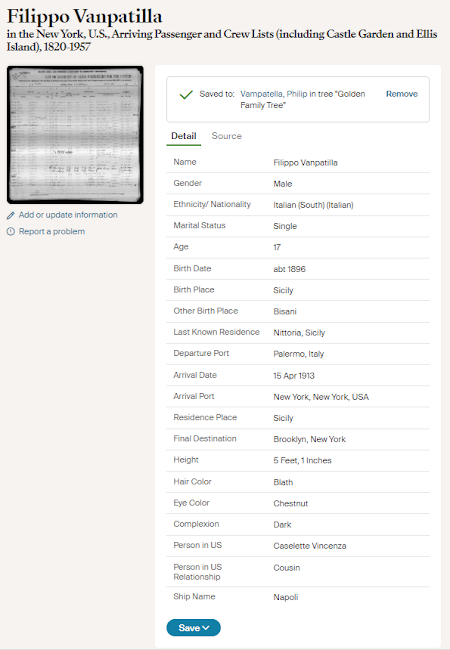
1896 September 14 - Filippo Vampatella was born in Biscari, Sicily. When dinner time came his mom would yell for him, "Filippo, vieni e mangia!" (Filippo, Come eat!) When he needed to be disciplined his father might say, "Filippo, non farlo!" (Filippo, don't do that!) 


Filippo's Civil Birth Record


1913 March 19th, Biagio and his son Filippo boarded the S.S. Napoli in Palermo. They left behind Filippo's mother, Angela, and his sisters Giovannina, Angelina and Maria in hopes to return home to their loved ones with money in their pocket for a better life. 

Searching for Filippo's immigration record was quite the challenge as the transcription of his name was "Filippo Vanpatilla". Making the discovery of his immigration more difficult. The copy of the record is poor and almost impossible to read and I can see how someone would transcribe his name incorrectly. 


1914 July - WWI broke out.  

1915 February - Philip as he was now called in America, writes in Passeggiata, "...word from Angela about some urgent business at home. So, Biagio borrowed some money, told his boy he would be back soon and boarded the first ship back to Italy." 

He continues to write, "Letters from home informed the boy Biagio could not come back right away but that he would as soon as he was able to." 

Although, I cannot be certain as to the urgent matter back in Italy that Angela referred to, I can speculate.  When Biagio and Filippo left Sicily in March of 1913 - Angela was expecting.  I don't know if Biagio knew or not, I'd like to think he didn't know.  On September 10th, 1913, in the town of Vittoria, Angela gave birth to a set of twin boys - Mario and Giovanni. Angela was now taking care of her 3 daughters, Giovaninna, Angelina and Maria as well as infant twin sons.  Maria, the twin's sister (our aunt Mary), indicated they died when they were 2. The cause of their deaths, whether illness or accident, remains unknown. 

1915 May 23 - Italy enters World War I.  In Passeggiata, Philip says he would get letters from his father, Biagio, 

Often he wrote his son to return home and do his duty in the army. Philip let his father's suggestions slip by unheeded but sent home some money every time he wrote.

From home news continued on the gloomy side.  Biagio, Angela and the girls felt the pinch of hunger; food was scarce due to so many men taken from the fields into the army. Few women were able to take men's places. 

Cousin Rosario had stopped an Austrian bullet somewhere in the Alps. Cousin Giovanni awaited induction, Cousin Biagio was still too young but anxious to go. Sister Giovannina had a sweetheart in the army. Sister Lina helped Angela care for a set of twins born since Biagio's return home; These two brothers Philip never came to know: they died in infancy.  Sister Maria was yet at school. 

 With this picture before his eyes, Philip could not reconcile himself with the idea he owed his native land anything.  Biagio continuously wrote him to return home and help win the war.  Philip never had enough money to pay passage back. He was blissfully ignorant of the fact he could have gone free of charge.  He continued to demure, some impulse telling him to stay back and work and keep sending money home.  Biagio wrote he would contact people in high place to compel his son to return and do his duty. 

Philip did not like this because he had begun to like America. He was afraid too, that Biagio, a man of his word, would carry out the threat. Philip left New Haven, assumed a spurious name, went to New Britain, stopped writing home.

Philip was caught between his family back in Italy and his new home, America.  Italians were not favorably looked upon here in the United States and a name like Vampatella was clearly an Italian name. Judgements were made just by hearing a name like that.  


1917 July 11th, he applied for Naturalization using the name Philip Vamptell. 


1918 January 18th, he joined the United States Army under the name Philip Vamptell.  he was a private in the 22nd regiment of the U.S. Infantry.


While in the army, he met with a sergeant Francois and had the following conversation:  


Off-handedly the sergeant fished for information. he wanted to know why the boy had misspelled his name.
'You seem to know your a-b-c's pretty well,' said the sergeant. 'I know most Italian names end in a, e, i or o. Why not yours?'

'Simple, sarge. I like to Americanize my spelling. That should be reason enough. But I don't mind telling you the real reason: I don't like to be in the Italian army.'

'That's a reason? Pretty slim, isn't it?'

'I'm not ashamed of the Italian army. I'm not ashamed of the misspelling of my name. I'm simply afraid.'

'Afraid of what? Do you think the American army is going to pamper you?'

'No, my father is still in Italy. For the last 2 years he has begged me to enlist in the Italian army. Since I have turned a deaf ear to his pleas, he has finally threatened me to have some responsible people in Italy contact some responsible people here to force me back to the old country.'

'That's a lot of bunk. They couldn't do that in the first place. Or could they?'

'I don't know. I just want to play it safe.'

1918 June, Philip along with 3 other soldiers were ordered to get on the ferry and then they were taken to City Hall in New York City.  The young men were scared, and one claimed, "I didn't do nothin!" They were ushered into a room with a man in a black robe, told to raise their right hands and made them swear allegiance to the United States of America and declared them US Citizens. Philip writes, "Philip had yet to grasp the importance of being an American Citizen, but not for long.  He only regretted the misspelling of his name."

Philip did not maintain the name Vamptell. He went back to using his Italian birth name of Vampatella.  He must have been bothered by his name change and in 1962, after he got married and had children, he didn't want that name haunting him or his children and had the following document drawn up declaring that Filippo Vampatella, Philip Vamptell and Philip Vampatella were the same person. 


My grandpa was a very special man.  So glad he wrote his story so the rest of us could understand and appreciate what he endured.  I'm proud he kept his name Vampatella!! 

Friday, January 26, 2024

 Prompt: Witness to History                                                                                 January 18,2024

World War II, indeed, was a global conflict that had a profound and lasting impact on the world we live in today. From 1939 to 1945, millions of people were killed, cities were destroyed, and the political landscape of the world was forever changed.  

The war was fought on land, sea, and air, with major battles taking place in Europe, Asia, and Africa.  Some of the most well-known battles include the Battle of Iwo Jima, the D-Day invasion, and the atomic bombings of Hiroshima and Nagasaki.

We've all seen movies, read books and heard stories. But there were those who lived and partook in this history. 

Biagio "Bennie" Philip Vampatella was 14 when the war started. Born in Connecticut on the 4th of July 1925, he was the first son of Philip and Antoinette Vampatella. As the naming pattern of Italian families go, he was named after his paternal grandfather. 

I imagine the family huddling around the radio and listening with anxiety and anticipation to the distant news of the day. Bombs, air raids, captures, injuries, and deaths occurring across the Atlantic and Pacific. Family discussions regarding the role of the United States and its allies against fascism, the role and the power of democracy and freedom. Bennie's father reminding his family what life was like in Sicily and how much better life was in the U.S. because this country heard the voices of its people in making laws and decisions and voting in the leader of the country. This is the "land of the free and the home of the brave".

In 1943, 2 days before he turned 18, Bennie enlisted in the navy. He was assigned to the U.S.S. Arkansas, a dreadnought battleship. The Arkansas was initially used to accompany occupied forces to Europe but help was needed on the sea to assist in the war effort.  The ship needed some repairs and updates. When they were completed, her first mission was June 6, 1944 off the northern coast of France - D-Day! 

Arkansas (BB 33) (navy.mil) - More Information about the U.S.S. Arkansas

Bennie was in the Gunnery Department along with many other men. The sailors would have been dwarfed by the sheer size of the 12-inch guns they toiled to load. These behemoths, towering like steel sentinels, were capable of hurling shells weighing over a ton, each one a monstrous harbinger of destruction for the enemy lines.  

Imagine the scene: Bennie, his muscles straining under the exertion, heaving on ropes thick as his arm to drag a shell up the loading ramp. his comrades, faces grim with determination, would be manhandling other components, their synchronized movements a desperate ballet against the clock. the Guns themselves, their dark bores glinting with malevolent purpose, would dominate the space, their every shudder a portent of the violence to come.

General Eisenhower lead the initiative of the allies to storm the beaches of Normandy. D-Day!!  The ship was located about 4,000 yards off Omaha beach.  All the men were aware that their goal was to bomb the hell out of the Germans in hopes of softening the enemy before the land invasion. The intensity of their mission was felt throughout the ship. This was the do or die moment for the allies. Bennie along with his fellow gunners, loaded those barrels and started firing about 6am for about 40 minutes before the assault troops landed on the beach.  The sounds of the guns were deafening, the acrid smell of cordite, the smoke and sweat burned their eyes as these crew members worked tirelessly to aid in the landing of the troops on Omaha Beach.

Bennie's father, Philip Vampatella writes in Passeggiata: When the firing ceased, "the forward part of the wooden cover over the steel decking of the Arkansas was torn up and in splinters, not from enemy shell hits but from concussion or vacuum created by her own blasts. That night Ben left the gun turret, found a spread tarpaulin on a section of deck, crept under it, went to sleep with his head resting on what appeared to be a sea bag. On awaking he found the ship heading westward and the object he had used a a pillow, the rigid body of a dead shipmate". 

Meanwhile, back in Great River, Long Island, New York, Ben's mom and dad listened to the radio and heard the first radio bulletin on NBC - 

https://www.youtube.com/watch?v=K9xk9GaV0NE

The Arkansas's job continued the 25th of June bombarding Cherbourg attacking the German fortification of the port.  The allies won!

From the end of June to September, Bennie and his fellow crewmates helped the allied forces in Oran, Algeria; Taranto, Italy; southern France; and Sicily then headed back to Boston for repairs. 

Bennie's little brother Philip was 4 years old when Bennie got leave.  Philip writes, "Now I really don't know if he had called ahead or if it was a surprise... but one day, big brother Ben appeared at the front door. He had gotten some time off while the ship was in port.  I remember jumping for joy, but most of all, I remember my mother, his mother, and her reactions. she grabbed him and wouldn't let go. she cried, she laughed, she loved, she kissed him. I never before (or since) seen such consummate joy in a human being as I saw in my mother that moment. But that's when the trouble started. Mom when she had collected herself, asked 'how long are you home for'? 'For a little while,' he said and I, a four year old, had no idea what a "little while" meant.  Was it minutes? Was it hours? all I know is that I broke into uncontrollable sobs because I thought he was leaving right away. As it was he was home for a week or so." 

The war continued and Bennie was now headed to the Pacific via the Panama Canal. The Arkansas was situated off the west coast of Iwo Jima in February 1945. The goal - the take the island and its airfields from the Imperial Japanese Army. They bombarded the Japanese resistance so the Marines could land on the island and take it over.  

In March of the same year they headed to Okinawa. For 46 days they bombarded the beach while the kamikaze's attempted to attack the Arkansas without success. A testament to the tenacity of its crew, who under Bennie's watchful gaze, kept the guns spitting defiance in the face of impossible odds.

Bennie's desire to fight for his country, defend against tyranny, and support a democratic way of life lead him into some of the most important battles of the war. He witnessed war firsthand and watched the tide turn in favor of the allies.

As Bennie stepped off the Arkansas at war's end, he carried within him the scars, both physical and emotional, of his wartime experiences. He had seen the face of evil, felt the sting of loss, and tasted the bitter sweetness of victory. But he also carried the unwavering spirit of a man who had stared into the abyss and emerged, forever changed, but unbroken. 


Tuesday, January 9, 2024


PROMPT: Origins                                                                                     January 5, 2024

When I was a little girl, I was always curious to know where in Italy my family came from.  Both grandfathers, it was said, came from beautiful sunny Sicily – my paternal grandfather from Palermo and my maternal grandfather from Siracusa.  My paternal grandmother’s family was from Milan and my maternal grandmother’s family was from Naples.  As with most of us, even today, many times when someone asks us where we are from, we tend to give them the nearest largest city.  Although I didn’t realize this in my early years, I did learn this as I was doing my family history. 

Years later, I set off on a quest to find exactly where in Naples my maternal great grandfather, Sebastiano “Steve” Rapuano was born. His date of birth was November 2, 1877.  I was armed with Grandpa Philip’s memoir, “Passaggiata”. The book painted a vivid picture of the man who would eventually become his father-in-law, Steve Rapuano. Philip tells of the time that he and his father Biagio were at the humble home of Sebastiano and Mariella Rapuano in New Haven, Connecticut for the first time. 

Philip writes, “It did not take long for the two fathers to get chummy after revealing each other’s family history. It appeared that Steve migrated from Puglianello, near Naples and landed in New Haven when he was in his early teens.”


Puglianello is a comune or municipality in the Province of Benevento in the region of Campania.  Puglianello is about 60 Km(37 miles) north of Naples. 


The search for a birth record for Steve started.  Antenati.cultura.gov.it, is an online treasure trove of Italian vital records.  I searched in Puglianello and in various years of birth without any luck.  This was a painstaking search that ended in disappointment. My search broadened to other comunes in the Provence of Benevento and stumbled upon Sebastiano’s birth record in a quaint village nestled in the mountains called FAICCHIO!! What a find!! Not only did it match his birthday, I learned the names of his parents! Angelantonio Rapuano and Mariantonia Friso or Freso – my great great grandparents – the people who are some of the reason I sit here today writing this story. I want to know more!


 Faicchio is 8.6 Km (5.3miles) north of Puglianello.

San Salvatore Telesino is 5.9 Km from Faicchio (3.6 miles) and 5 Km from Puglianello (3.1 miles)


Angelantonio Rapuano was 31 years old in 1877 so I took an educated guess that he was born about 1846 in Faicchio.  The search was grueling, always ending in disappointment.  As I was perusing through ancestry.com, my curiosity was piqued by a man who had a huge Rapuano/Rabuano family tree. The “p” and “b” have similar sounds and many times they are interchanged in the records. Tom was good enough to answer my messages and lo and behold, we are very distant cousins along the Rapuano line. His thorough and extensive research had me focus on a very ancient village called San Salvatore Telesino.

BINGO!! Angelantonio was born 25 September 1846 in San Salvatore Telesino to Sebastiano Rapuano and Maria Grazia di Brigida!  I am now dancing throughout the house and yelling, “I found it!” to anyone who would listen! (My poor husband Mark).

Tom’s research has led him to discover some of our oldest Rapuano/Rabuano ancestors, two of whom are Nicola and Cleto who were born in the late 1500’s.  It is unknown how they may be related, but it is likely they are our 10th Great Grandfathers. 

Without Tom’s expert experience, I may never have found the origin of my Rapuano/Rabuano ancestors.


Sunday, April 2, 2023


“Starts with a vowel”                                                                                                           


April 2, 2023

Anna and the Airplane


I would like to Announce to you my “Starts with a vowel” prompt and my mother - Anna Dolores Golden nee Vampatella, born May 26, 1930 and died January 7, 2012.    Anna had a lot of Admirable Attributes and some interesting ones.


Anna’s Artistic Acumen was Astounding! She loved to sit in her chair watching TV and sketching whatever came to her head. When sketching, her preferred Aesthetic was focused on the Awesome beauty and Allure of women and nature. She especially loved sketching women – their faces, their hands, their beauty.  Her Artistic interest moved to painting with oils and would Aspire to be like Bob Ross and Absorb his tips on painting landscapes.  Only once do I remember Anna taking an Adult Ed Art class with my Aunt Marie, her sister. When she was younger, she created a mermaid made of clay. Not only did she sculpt the mermaid but she painted her.  I remember loving that mermaid. I know the mermaid broke but I do not remember if I was the culprit or was it just due to time. I was Astounded as a child as I am now to think of the Affinity for Art that lay in her fingers.

This was one of her "doodles"!! 

Anna Adored her children, grandchildren and all her family – they were everything to her! The Admiration went both ways – we loved her too!

Anna had an Addiction to Alcohol and cigarettes.  She Attached herself to Alcoholics Anonymous to help with her Addiction to Alcohol. When she died, she had more than 40 years of sobriety!! Her courage to battle this disease was Amazing and Admirable.  Cigarettes was a far more difficult Addiction to Abandon and she smoked for more years than I will ever know.  Emphysema was the Aftereffect of smoking and she Agonized with each breath. She became Attached to her oxygen. 

So, what does this have to do with the Airplane?  Nothing, I just wanted to Acquaint you with my Amazingly Awesome mother Anna.

The Airplane: There was a time when my brother, Charlie who lived in Arizona and had some Ailments. Mom, my brother Robbie, sister-in-law Ronnie and I decided to go to Arizona to see my Ailing brother. 

Anna also had some Anxiety. Anxiety that Affected others. One of her Anxiety related issues was to Airplanes. Not the Airplane itself but flying on Airplanes. 

In Anticipation of the Airplane flight, Anna got a special oxygen tank that could be used on an Airplane. The Apprehension of the flight to Arizona only Augmented the Anxiety.  Robbie and Ronnie sat behind us.  Mom was on an Aisle seat and I was in the middle with her oxygen tank under the seat in front of me. Mom’s Angst made her do some very funny things.  I’m laughing as I write this. 

 As we started taxiing, I was trying to Avert mom’s Attention by talking to her about Anything I could think of.  I’m watching her and I notice she is leaning into the Aisle and staring straight Ahead but I kept talking to her.  She is not Answering me but I kept talking hoping to Alleviate her Anxiety. She finally turns to me and Annoyingly Announces, “Would you please stop talking, I’m trying to help the pilot fly the plane!” ….. Oh, Mama!!

Anna’s Absence has Affected me dearly, but her Antics will Always be Adhered to my heart.

Monday, February 27, 2023


“Gone too Soon”                                                                                     February 27, 2023


I have given this so much thought. There are so many who I feel have gone too soon or gone too young.  Although my heart hurts when I think of ALL those that that have passed and I miss them terribly, there are those who I feel their lives were cut short and “gone too soon”.  I’d like to share with you those people.  

Nathanial Golden: died at the tender age of 10 in a vehicle accident. Nate was the son of my nephew Charles Victor Golden who is the son of my brother Charles Philip Golden. I never met Nate but was told by many that he was a wonderful, happy, loving young person. Seems like God got one of the good ones early!!

Gregory Golden: died at the age of 23. Gregory was the son of my brother Robert Richard Golden. Gregory was a loving, kind, helpful young man. He was there when you needed him, he was great at helping with conflict and having your back when you needed it.  Truly a great loss for the family.

Charles Philip Golden: died at age 67 from heart disease.  Charlie was my brother. Charlie was a talented musician and loved making people laugh. He was playing the accordion at age 5 and could pick up almost any instrument and play it. He had an adoring wife and 3 terrific kids. 

Charles Victor Golden: died at age 69 from heart disease and cancer. Charlie was my father. I was one of the lucky ones to have a terrific daddy.

Charles Edward Gallagher: died at age 66 of a very brief illness. Charlie was my father-in-law; Mark’s dad.  He was a very loving and kind man who adored his family.  He was so happy when he started having grandchildren. He would walk around town with the carriage (yes, carriage, not stroller) showing off the baby.

Charles Francis Gallagher: died at age 40. He was Charles Edwards’s father - Mark’s grandfather.  This man came to the United States when he was 22 from Donegal, Ireland.  He too died from a brief illness when his only child was just 2 years old. It’s no wonder that Charles Edward treasured his family.

Marie Eleanor Caddell nee Vampatella:  died at age 41 from cancer. Marie was my maternal aunt.  She was a beautiful woman who had a hard life with a mean husband.  She loved her nieces and nephews. She too had a knack for music.  One day she just started playing the piano and her siblings would gather round and sing with her. 

Angelina Skrocki nee Vampatella: died at age 48 from cancer. Angelina was my maternal aunt. She was a very funny lady who will always have a very special place in my heart.

Antoinette Vampatella nee Rapuano: died at age 56 from cancer.  Antoinette was my maternal grandmother.  I was two years old when she passed and have no memory of her.  Everyone said she was a sweet loving lady. I took her name as my confirmation name to honor her. My oldest daughter was born on her birthday – April 27th.

Carmen Rapuano: died at age 25 in 1946 from heart anomaly. He was going to the minor leagues!  Baseball was in his blood.

There are so many others. I think of the Vampatella twins that died in Sicily when they were two years old and their father was in the United States trying to make some money for his family, Salvatore Vampatella who died as child from tetanus in Sicily, and all the others that we will never know about, no matter how much research we do. 

Gone too soon….Gone too young…. Gone but hopefully not forgotten.

Thursday, February 16, 2023


“I Can Identify”                                                                                        February 16, 2023

 As I embarked on my genealogical journey for both Mark and me, it was important to know who came to the United States and when.  Who was the FIRST to arrive?

For my side of the family I identified the following:

  • ·       Andrea Titone arrived 1899 – Santa Margarita, Sicily, Italy
  • ·       Carlo Beccherini arrived 1903 – Borghetto, Lodigiano, Italy
  • ·       Angelina Maria Bianchi arrived 1904 – Treviglio, Italy
  • ·       Philip Vampatella arrived 1913 – Vittoria, Sicily, Italy
  • ·       Sebastiano Rapuano arrived 1889 – Benevento, Italy
  • ·       Mariella Fazio arrived 1897 – San Valentino, Italy

For Mark’s side of the family I still struggle.  So far I have identified the following:

  • ·       Charles Francis Gallagher arrived 1908 – Ballyshannon, Donegal, Ireland
  • ·       Edward Duffy arrived about 1890 – somewhere in Ireland
  • ·       Katherine McMahon arrived about 1895 – somewhere in Ireland
  • ·       George Huneke unknown arrival but likely from Germany
  • ·       George Huneke’s wife???
  • ·       Anthony Rush arrived 1853 – ROSCOMMON, Ireland
  • ·       Ellen McLaughlin arrived about 1860 – somewhere in Ireland
  • ·       Leo Mendus arrived 1878 – probably from Lipiniak, Galicia, Poland
  • ·       Pauline Kreher arrived 1897 – possibly from Austria or Poland Przemysl (pronounced Shemmish) in Galicia Poland


When doing any kind of genealogical research it is very important to find the country, the county and then the town the ancestor came from.  At this moment, Anthony Rush won the prize for being the first of our ancestors to arrive in the United States!! Yay, Anthony!! But Anthony does not say where he came from in Ireland. I know, you see Roscommon next to his name---read on.

 an Gorta Mór – The Great Hunger

Anthony was born 16 November 1835 or that’s what he always claimed.  Birth dates were not always accurate.  Nonetheless, he was probably a happy little boy playing on the farm with his parents and siblings (I do not know of any siblings at this time). The fields were lush, lots of rocks, and the sun shone through from time to time.  In 1845 a fungus caused the potatoes, a main staple of the Irish farmer, to turn black and inedible. They could not eat them nor sell them causing a great deal of starvation and homelessness.  This blight ended about 1852. What did he endure during those years? Did he lose his parents? Siblings? Did he have to stay in a workhouse? What we do know is that he came to the US in 1853. Did he go to England then to the US? Or just come to the US directly?

 Here is a wonderful article regarding the potato famine: https://tinyurl.com/d68ek76h


Civil War

Details about where Anthony was and what he was doing in the United States after he arrived is unclear, but we do know he entered the Civil war 31 March 1862.  He volunteered for the 78th NY Infantry company C.  He was in the war until the end, mustering out on 21 July 1865.  Usually, military documents are a wealth of information, but Anthony was less than forthcoming regarding where he came from in Ireland.

I decided to obtain his complete pension files and Compiled Military Records from National Archives and Record Administration (NARA). Hundreds of pages to read through and I found out where and when he was married and the name of the priest who married them, where he was living, who his wife and children were, how tall he was and how much money he was receiving from his pension, but still no location in Ireland, Listing only the country and not the county, as the Irish normally would.

Anthony was requesting an increase in pension for the gun shot wound he got to his left index finger during the Battle of Chancellorsville in 1863. (Mark and I visited the battle site and were able to track his unit’s moves on preserved and marked maps.)  He was deposed many times, but on the 3rd of March 1905 in the state of Tennessee at the Mountain Branch National Home for Disabled Volunteer Soldiers, he finally says he was born in Roscommon, Ireland!!  

After many years of searching, I finally was able to Identify the county in Ireland from which he came! Now to identify a town in Roscommon!! Sigh……


Wednesday, February 1, 2023


January 30, 2023

I just signed up to write about 52 ancestors in 52 weeks This is week 3 (yes, I’m a little behind – no surprise there!). Each week I’m given a prompt. This week’s prompt:

EDUCATION:

I told Mark, my husband, about this prompt and I said it HAS to be about Grandpa Vampatella and he said, “which story?” I had to think about that! Was it the story about his education or the story about how he tried to dissuade me from getting an education. 

Grandpa Vampatella, Philip Vampatella, was born in Biscari, Sicily in 1897.  He was the oldest child of Biagio Vampatella (born 3 Feb 1869) and Angela Falconieri (born ? in Biscari, Sicily). Biagio worked for the Italian railroad and lived in a small casello (house) near the tracks. Biagio could read and write in Italian and he wanted his son to be able to do the same.  Biagio’s job took him to various towns throughout Sicily and there were no schools near the railroad tracks.  Grandpa writes in his book, “Passeggiata””

“At seven Philip started going to school. Schools along the track were non-existent.  At a place called Donnafugata was a medieval castle belonging to a duchess of Albarfiorita. It was about 5 miles from the casello and it did not belong to the railroad.…… At school Philip progressed slowly, considering the time he consumed en route to and from it. After a while teaching was passed to the doorman, who charged forty cents per month to impart knowledge into the skulls of striplings from six to fourteen years of age.

One of these schools was in a town named Comiso. Always in the first grade Philip resumed his education from the beginning at every new place. In Comiso a priest teacher put him in the second grade to start with but promoted him to the first soon after he discovered what Philip could do.  Philip, to all accounts was a qualified “somaro” (Donkey).

It was the responsibility of the man to be able to provide for his family and thus Biagio sent his son to learn a trade. He worked in a shop that separated cotton fibers from seeds, he worked as an apprentice shoemaker, coppersmith, stone quarry, cabinet makers and many others.  None of which suited him.  He writes, “Much as he tried to do things to satisfy his teachers, his ineptitude always brought him to deal with menial chores utterly unrelated to the trades.”

However, he does say in his book that he did take to cabinet making. Anyone who is descended from grandpa, probably has something he made in their house.

As time went on, he did better in school and took to reading, but there were not a lot of books. One time he memorized homework regarding national history and his teacher was so impressed he got a reward – a book about Theodore Roosevelt in Africa. He also took to arithmetic and biology, but history was his strength.  He says, “he entered school as a first grader but in two years he was promoted to the fourth”.

When Philip arrived in the United States, he could not read, write, or speak English.  But he was bound and determined to learn.  He would go to movies, pay attention to English speakers and go to the library – the concept of so many books that could be borrowed was astounding to him.  He would also read the dictionary.  Words were very important to him. He became proficient in English – so proficient he could write this beautiful book. 

Yet, it was only important for the male to learn.  When I was in high school and deciding where I wanted to go to college, grandpa very kindly and gently explained to me that it was not important for me to get an education as my husband would provide for me.  That was 1976 – which for many may sound like the dark ages – but it wasn’t and I was NOT going to listen.  My mother had only finished 10th grade – a piece of knowledge I only learned recently. My father did not complete high school either but did go back for his GED. 

Education – I am so impressed by what my grandfather accomplished in his lifetime, disappointed that he felt it was only for males, proud of myself for succeeding in college and grad school.

Hey, Grandpa!! What do you think now?????

Saturday, January 21, 2023

Hello, Family and Friends!!

 In early 2001, a family member received an email from someone with the last name of Vampatella from Australia.  When they had googled Vampatella, they found a boat load of information on Philip Vampatella fighter pilot - my uncle. Vampatella is not a common name, so when the Australian person found Uncle Phil, they contacted him to see if they were related.  Over many months and emails (yes, I printed them out and I still have them!) there was never a resolution to the question, "Are we related". 

The story was that there was a man name Vampatella born in Italy and put up for adoption. He was adopted by an Australian family and moved there.  Uncle Phil had hired a researcher to look into this possibility and no answer could be found.  Now, there are many holes in this story, but there was a great deal of fun speculating on "who could have done the deed"!

Grandpa Vampatella, also with the given name of Philip, had written a book called Passeggiata. Can you see where I got the title of my blog from? He wrote this book with a typewriter in 1965 as a biography when in reality it was an autobiography.  He was very creative.  Philip Vampatella was born in the town of Biscari (now called Acate) in the province of Ragusa on the island of Sicily in the country of Italy on September 14, 1897 and he died October 13, 1983 in Bay Shore, New York. If there was a story about a child who was given up for adoption, we suspect he would have known, but that secret would have been buried with him - if there was a story. 


Now, forward to November 2012, Mark, my husband, and I decided to take a trip to Vittoria, Sicily, the town grandpa grew up in. With the Passeggiata in hand and an address in Vittoria that the research from years prior had discovered, Mark and I drove from Rome to Sicily to look for my grandfather's story/relatives or whatever we could find...including the mystery.   

Grandpa was excellent at describing things including the house he had lived in. 

"The casello was a two-story building, the copy of which was planted at every  kilometer along the (railroad) track that linked the various towns and hamlets in that part of Sicily. The building was designed to house two employees and their families. It was rent-free, one room down, one upstairs for each family." 

 I was reading this to Mark as we were entering Vittoria when all of a sudden he pulls the car off to the side of the road and jumps out of the car. I am startled by this and jump out after him when he says, "This was your grandfather's house!!" And there, just over the railroad tracks, was the casello that grandpa so beautifully described. 

Further on we went to the address, Via Principi Umberto #13, Vittoria - The home of my great grandfather, Biagio Vampatella. This uninhabited abode was crumbling, but in my eyes it was beautiful. Not far was the cathedral - Basilica of St. John the Baptist. We walked over and spoke with a person regarding Vampatella ancestors. Before we arrived in Italy, Mark had used an app to learn to speak Italian. And of course, he could really get by! The church gave us the name of the archivist, Salvatore Palmeri and we met with him the next day. 

Up the narrow dark stairway in a building not far from the church, we entered a small room with books dating from the 1600's all written in Latin.  One by one, Salvatore went back through time and found many ancestors. The earliest Vampatella to arrive in Vittoria was Pietro Vampatella born 1676 in Chiramonte Gulfi. What had life been like back then? He could not find the unknown Vampatella that was given up for adoption. He suspected the adopted Vampatella was not related.  

We could never come to an absolute conclusion regarding the relationship of the Vampatella in Australia to Vampatella's of my family, but years later my first cousin did a DNA test as did the Vampatella descendant in Australia, and they did not share DNA. 

So, that's it!! That's how Cathy's obsession with genealogy got started. Thanks to the unknown Vampatella in Australia and Grandpa Vampatella's book. 


The Story of Angela Falconeri Angela Falconeri was born on October 12, 1876, in the small Sicilian town of Acate (then called Biscari). She ...